ANI
19 May 2025, 22:49 GMT+10
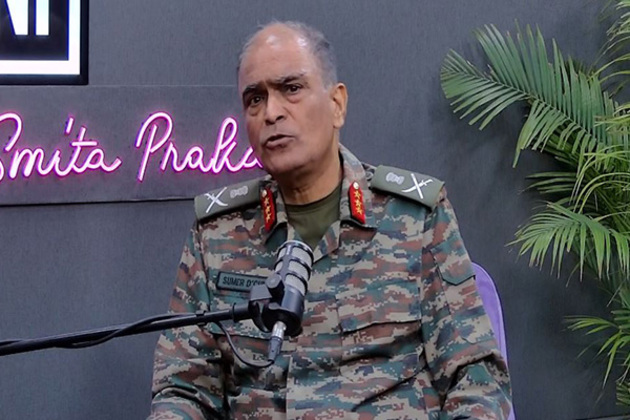
New Delhi [India], May 19 (ANI): Director General of Army Air Defence Lt Gen Sumer Ivan D'Cunha, on Monday highlighted India's preparedness in modern warfare, particularly in neutralising drones and other advanced technologies during Operation Sindoor.
Speaking to ANI, Lt Gen Ivan D'Cunha said that Pakistan's attempt to use drones against India was anticipated by the Indian defence forces, which conducted simulation exercises to prepare for potential drone attacks.
Pakistan first sent cheap drones in large numbers to low altitudes to saturate the radar system. Still, the Army had anticipated the drone threat and conducted a simulation exercise on April 26-28 to prepare for potential drone attacks.
Speaking about the internal training by the Indian side, Lt Gen D'Cunha said, 'I think that the training that we did, actually we anticipated this and you won't believe that about maybe on the 26th, 27th and 28th, we did a simulation exercise at the behest of our army chief in the border areas, where we simulated drone attacks on the weapon system. It was not from the border, but it was internal, on the border... We started at 5:30 in the morning, maybe on the 26th for the first day, when multiple drones were coming in to train our people...'
The operation highlighted India's integrated command structures, enabling seamless coordination between different military branches.
The Indian Army adopted a tactical approach by not continuously emitting radar signals, instead switching them intermittently to engage targets within gun range.
India utilised advanced surveillance systems, including satellite surveillance and real-time intelligence, to gather critical information on enemy positions and movements.
India's electronic warfare assets played a crucial role in neutralising Pakistan's command-and-control structure, which would have likely been used to deploy drones.
The Indian Air Force's Netra AEW&C aircraft jammed Pakistani radars, disrupting their ability to track and respond to Indian aircraft, including drones.
During Operation Sindoor, India's offensive strikes targeted key Pakistani airbases- Noor Khan and Rahimyar Khan with surgical precision. The Ministry of Information and Broadcasting in a statement had said, 'Loitering munitions were used to devastating effect, each finding and destroying high-value targets, including enemy radar and missile systems. Loitering munitions also known as 'suicide drones' or 'kamikaze drones', are weapons systems that can hover or circle a target area, searching for a suitable target before attacking.'
All strikes were executed without loss of Indian assets, underscoring the effectiveness of our surveillance, planning, and delivery systems. Modern indigenous technology, from long-range drones to guided munitions, made these strikes highly effective and politically calibrated.
Lt Gen also highlighted the significant role of drones in modern warfare, citing recent global conflicts and gave examples of how the Nagorno-Karabakh, Russia-Ukraine, and Israel conflicts have demonstrated the vast potential of drone warfare.
Countries like Ukraine and Russia are ramping up drone production, with Ukraine aiming to manufacture millions of drones annually.
While speaking with ANI, Lt Gen D'Cunha said, 'So, you know, it's like that the Nagorno-Karabakh-Azerbaijan clash, the Russian-Ukraine clash, and even to some extent, the Israeli current conflict going on, taught us about the huge capability that drones have. And we realised that Pakistan, by its backend support from Turkey and any, maybe our northern adversary as well, had a plethora of drones. And we also knew that to take on an effective air defence integrated system that we have, like the army and the air force are integrated in this case, they would have to saturate us. If you see their concept of employment, they would first send in low-altitude, cheaper drones in large numbers to saturate your radars and force you to open them up. So, I think it's very important that the army looked at not emitting so that we didn't give out our positions...'
Notably, the conflict between Armenia and Azerbaijan over the disputed Nagorno-Karabakh region included the heavy use of missiles, drones, and rocket artillery.
As per the Center for Strategic and International Studies (CSIS), the 44-day war featured a diverse array of legacy and advanced air and missile strike and defence platforms. Drones of Russian, Turkish, Israeli, and indigenous designs performed both reconnaissance missions to support artillery use and strike missions. Unmanned aerial vehicle (UAV) and loitering munition attacks were able to destroy heavy ground units, including T-72 tanks and advanced S-300 air defences.
Azerbaijani drones were the centre of attention in this war. Although Armenia deployed some of their own indigenously produced drones, and later footage showed its side using the more sophisticated Russian-made Orlan-10 UAV, Azerbaijan took control of the skies.
Drones also became a central weapon in the Russia-Ukraine war. According to the European Council on Foreign Relations, Ukraine aimed to produce one million drones within the year, as early as 2024.
In March 2024, that goal was revised to two million, and in October, Ukrainian President Volodymyr Zelenskyy announced the country could manufacture up to four million drones annually. Russia was also reported to be matching this pace of production. It is estimated that about 100 different types of drones are in use in Ukraine, ranging from toy-sized systems to larger models with wingspans of almost 20 metres. (ANI)
Get a daily dose of Arab Herald news through our daily email, its complimentary and keeps you fully up to date with world and business news as well.
Publish news of your business, community or sports group, personnel appointments, major event and more by submitting a news release to Arab Herald.
More InformationDonald Trumps Middle East tour conspicuously excluded the Jewish state, potentially signaling the start of a new foreign policy paradigm...

Allahabad (Uttar Pradesh) [India], May 19 (ANI): The Allahabad High Court on Monday upheld the trial court's order to survey the Shahi...
Munich [Germany], May 19 (ANI): The World Uyghur Congress (WUC) recently released its weekly briefing, spotlighting recent significant...
More than 50 young diplomats from 20 countries attended the annual event in Kazan The Russian city of Kazan has hosted a forum of...
As the 2025 SCO summit is approaching, Tianjin stands ready to facilitate new SCO chapters in building a community with a shared future....
VATICAN CITY, 19th May 2025 (WAM) -- The Muslim Council of Elders participated in the inauguration of His Holiness Pope Leo XIV as...
WASHINGTON, DC - A coalition of 29 U.S. senators, spanning both parties, introduced a resolution on Thursday calling on the Trump administration...
GAZA - Israel Air Force pilots have heavily bombarded Gaza this week, killing hundreds and severely wounding hundreds more. The...
DOHA, Qatar: Boeing secured its largest widebody aircraft deal this week, as Qatar Airways placed firm orders for 160 jets with options...
(Beirut) - Egyptian Ministry of Interior officers on April 10, 2025, apparently killed two men in northwest Egypt hours after their...
New Delhi [India], May 19 (ANI): Director General of Army Air Defence Lt Gen Sumer Ivan D'Cunha, on Monday highlighted India's preparedness...
Donald Trumps Middle East tour conspicuously excluded the Jewish state, potentially signaling the start of a new foreign policy paradigm...