ANI
10 Jul 2025, 15:33 GMT+10
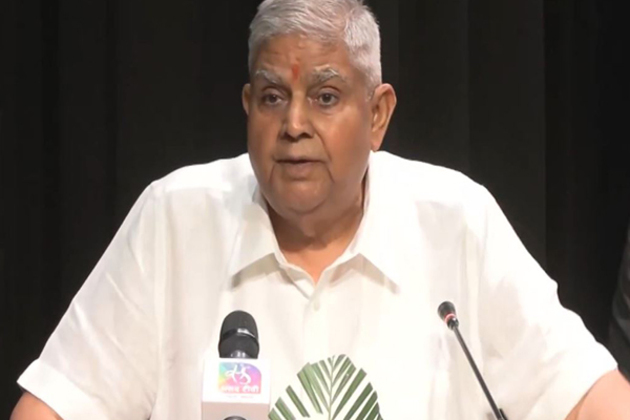
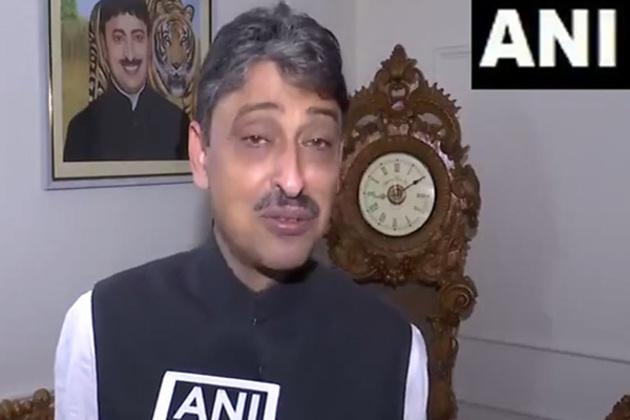
New Delhi [India], July 10 (ANI): India's rise as a global power must be accompanied by the rise of its intellectual and cultural gravitas, said Vice President Jagdeep Dhankhar on Thursday, noting that a nation's strength lies in the originality of its thought.
Addressing the inaugural annual conference on the Indian Knowledge System (IKS) in Delhi, he emphasises the importance of soft power for the rise of a nation-state.
'India's rise as a global power must be accompanied by the rise of its intellectual and cultural gravitas. This is very significant as the rise without this is not lasting, and the rise without this is not in harmony with our traditions. The strength of a nation lies in the originality of its thought, the timelessness of its values, and the resilience of its intellectual traditions. That is the kind of soft power that endures, and soft power is potent in the world we live in,' Dhankhar said.
Reaffirming India's identity beyond the confines of post-colonial constructs, the Vice-President observed that India is not just a political construct formed in the mid-20th century. It is a civilizational continuum--a flowing river of consciousness, inquiry, and learning that has endured.
Critiquing the historical sidelining of indigenous wisdom, he said that while indigenous insights were dismissed as relics of the primitive past, it was not an error of interpretation.
'It was an architecture of erasure, destruction, and decimation. What is more tragic is that the selective remembrance continued even after independence. Western constructs were paraded as universal truths. To put it more bluntly, untruth was camouflaged as truth,' he said.
'What should have been our fundamental priority was not even on the radar. How can you not be cognizant of your core values?' he questioned.
Reflecting on the historical ruptures in India's intellectual journey, the Vice-President said that the Islamic invasion of India caused the first interlude in the glorious journey of Bharatiya Vidya Parampara.
'Instead of embrace and assimilation, there was contempt and destruction. The British colonisation brought forth the second interlude, when the Indian Knowledge System was stunted, stymied, and subverted. Centres of learning changed their motives. The compass was moderated. The North Star was changed. From bearing Sages and Savants, it started producing clerks and yeomen. The needs of the East India Company to have brown babus replaced the need of the nation to have thinkers,' he said 'We stopped thinking, contemplating, writing, and philosophising. We started cramming, regurgitating, and swallowing. Grades, unfortunately, replaced critical thinking. The great Bharatiya Vidya Parampara and its allied institutions were systematically drained, destroyed, and decimated.', he mentioned.
Dhankar said that long before the Universities of Europe came into being, Bharat's universities had already established themselves as thriving centres of learning.
'Our ancient land was home to luminous centres of intellectual life--Takshashila, Nalanda, Vikramashila, Vallabhi, and Odantapuri. These were the towering citadels of knowledge. Their libraries were vast oceans of wisdom, housing tens of thousands of manuscripts,' he said.
He added, 'These were global universities, where seekers came from lands near and far, such as Korea, China, Tibet, and Persia. These were the spaces where the intellect of the world embraced the spirit of Bharat.' Calling for a more holistic understanding of knowledge, the Vice-President said that knowledge resides beyond manuscripts. It lives in communities, in embodied practices, in the intergenerational transmission of wisdom. 'A genuine Indian Knowledge Systems research ecosystem must honour both the written word and the lived experience--recognizing that insight emerges as much from context as it does from text,' he said.
Calling for focused action to strengthen Indian Knowledge Systems, the Vice-President remarked, 'Let us therefore turn our attention to tangible action because that is the need of the hour. The creation of digitized repositories of classical Indian texts is an urgent priority covering all classical languages such as Sanskrit, Tamil, Pali, and Prakrit, to name just a few.'
He added, 'These repositories should be made widely accessible, enabling scholars in India and researchers around the world to engage meaningfully with these sources. Equally essential is the development of training programs that empower young scholars with robust methodological tools, blending philosophy, computational analysis, ethnography, and comparative inquiry to deepen their engagement with the Indian knowledge system.'
Quoting renowned scholar Max Muller, the Vice-President said, 'If I were asked under what sky the human mind has most fully developed some of its choicest gifts, has most deeply pondered on the greatest problems of life, and has found solutions of some of them which well deserve the attention even of those who have studied Plato and Kant--I should point to India.'
'Friends, it was nothing but the articulation of eternal truth,' the Vice-President said.
Touching upon the dynamic relationship between tradition and innovation, the Vice-President stated that the wisdom of the past does not obstruct innovation--rather it inspires it.
'The metaphysical can speak to the material. Spiritual insight can coexist with scientific precision, but then you have to know what spiritual insight is.'
'The Rigveda's hymns to the cosmos can find new relevance in the age of astrophysics. The Charaka Samhita can be read alongside global debates on public health ethics,' he added.
'As we navigate a fractured world, we are stunned by global conflagration. So we are faced with a fractured world. Knowledge systems that have long reflected on the interplay between mind and matter, the individual and the cosmos, duty and consequence, become relevant and vital to shaping thoughtful, enduring responses.', he concluded. (ANI)
Get a daily dose of Arab Herald news through our daily email, its complimentary and keeps you fully up to date with world and business news as well.
Publish news of your business, community or sports group, personnel appointments, major event and more by submitting a news release to Arab Herald.
More InformationNew Delhi [India], July 10 (ANI): India's rise as a global power must be accompanied by the rise of its intellectual and cultural gravitas,...
Gangtok (Sikkim) [India], July 10 (ANI): BJP MP Nishikant Dubey on Thursday slammed Uddhav Thackeray and Raj Thackeray amid the Hindi-Marathi...
Dhaka [Bangladesh], July 10 (ANI): The International Crimes Tribunal (ICT), a Bangladesh court designated for the trial of international...
Guwahati (Assam) [India], July 9 (ANI): The Assam unit of the Bharatiya Janata Party (BJP) on Wednesday reiterated its support for...
New Delhi [India], July 9 (ANI): The Delhi High Court on Wednesday reserved order on bail pleas of Sharjeel Imam, Umar Khalid and six...
New Delhi [India], July 9 (ANI): Congress MP Imran Masood on Wednesday accused the Uttar Pradesh government of propagating 'hatred...
DUBAI, U.A.E.: Saudi Aramco is exploring asset sales as part of a broader push to unlock capital, with gas-fired power plants among...
CAIRO, Egypt: This week, both Hamas and Israel shared their views ahead of expected peace talks about a new U.S.-backed ceasefire plan....
Egyptian-Chinese relations in the last 10 years have become a model for a comprehensive partnership built on respect, trust, understanding...
New Delhi [India], July 10 (ANI): Oman is set to host the combined ICC Men's T20 World Cup Asia and East Asia-Pacific Qualifier in...
ABU DHABI, 10th July, 2025 (WAM) -- President His Highness Sheikh Mohamed bin Zayed Al Nahyan has sent a message of condolences to...
AJMAN, 10th July, 2025 (WAM) -- Ajman University has achieved a new global milestone by ranking in the 301-400 band in the Times Higher...