The Conversation
27 Aug 2025, 06:14 GMT+10
Share article
Print article
With news Iran orchestrated two antisemitic attacks in Australia last year, the federal government has declared the Islamic Revolutionary Guard Corps a terrorist group.
The Australian Security Intelligence Organisation's Director-General Mike Burgess said the group, known as IRGC, "used a complex web of proxies to hide its involvement" in the attacks on Lewis Continental Kitchen in Sydney and the Adass Israel synagogue in Melbourne.
The IRGC has a long history in the Middle East as an extremely powerful armed force, both militarily and politically.
Here's where it came from, how it operates and what it means for Australia.
The IRGC was created after the 1979 Islamic Revolution, in which the Western-backed Shah of Iran was deposed by followers of Shia Islamic cleric Ayatollah Ruhollah Musavi Khomeini - the first Supreme Leader of the Islamic Republic of Iran.
The organisation was originally created as a force to protect the revolution, both within Iran and internationally. It's legislated in the Iranian constitution, which says:
The Islamic Revolution Guards Corps, organised in the early days of the triumph of the Revolution, is to be maintained so that it may continue in its role of guarding the Revolution and its achievements.
Iran has an army, which is bigger than the IRGC, and reports directly to ministers and government in the same way the Australian Defence Force does.
The IRGC, on the other hand, was created alongside the army but instead reports directly to Iran's Supreme Leader and other high-level clerics. It proactively defends Iran's interests, in what scholars call a forward-defence strategy.
Given it's so closely connected to the most powerful people, the corps has a lot of political influence, even more than the army. The IRGC is occasionally at loggerheads with the clerical elite, which undermines the power it has to go up against the people it directly reports to.
The IRGC Aerospace force has control over much of Iran's extensive ballistic and cruise missile arsenal, many of which were deployed against Israel earlier in the year.
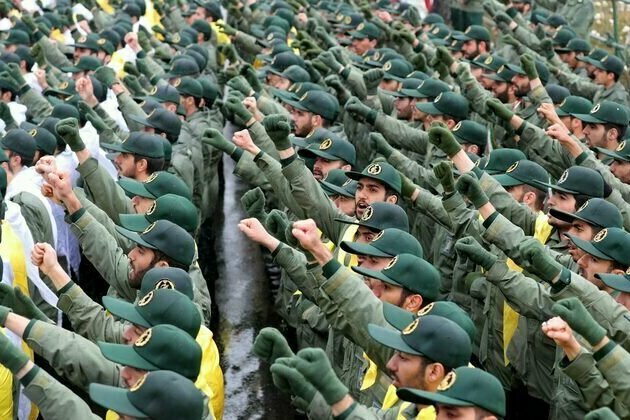
It's hard to know exactly how big the IRGC is, but the best estimates think it's made up of about 150,000 personnel.
This force is broken into two main branches: the Basij and the Quds.
The Basij is a volunteer militia operating within Iran as a domestic policing force. It's known for quashing dissent and protest against the government, sometimes violently.
The Quds force operates internationally, primarily in the Middle East. It typically funds, trains and arms other forces in the region, such as Hezbollah in Lebanon, the Houthi Rebels in Yemen and Hamas in Gaza.
To describe the corps as a militia would be to oversimplify its many roles in Iranian politics, crime, business and natural resource management.
The IRGC has long been involved in operating black markets, with some estimates saying up to a third of imported goods to Iran are delivered to underground economies and illegal jetties.
Such goods include tobacco, alcohol and narcotics, which the corps then distributes through black markets.
The organisation also engages in widespread bribery for business and government contracts and permits.
Agriculture also falls under the corps' ever-expanding remit, as does restricting the supply of basic resources such as water.
In short, there are very few sectors in Iran the IRGC is not involved in, and even fewer it's not actively controlling.
Interfering in the affairs of other countries is so much of what the IRGC does that it could be considered its main calling card. This has been the case for decades.
Typically, this interference is in neighbouring countries in the Middle East by backing insurgent forces with which it is politically sympathetic.
The biggest example of this is in the growth of Lebanese paramilitary group Hezbollah. It grew from being a small insurgency in the 1980s to a massive paramilitary force through the financial and training backing of the IRGC.
By operating with proxies in this way, the corps - and by extension Iran - claim plausible deniability for many of the incidents they're involved with. By maintaining an extra degree of separation, the group can take some of the diplomatic heat off the Iranian regime.
The actions in Australia demonstrate similar tactics, albeit on a lower scale.
Given the nature of such clandestine activities, it's hard to know for sure why the IRGC is targeting Australia.
That said, we can look at the broader international context for some clues.
The first thing to point out is for groups like the IRGC, backing attacks in Australia is relatively low-risk. They don't need to put their people in harm's way, or even spend much money.
It's likely the corps set up some social media accounts as part of its offensive "social enineering" cyber strategy in an attempt to radicalise people in Australia online. This is a large part of how it operates elsewhere.
Broadly speaking, authoritarian regimes like Iran are learning they benefit by sowing social discord overseas. If you can create uncertainty or fuel identity politics, it can be exploited.
If being antisemitic becomes more acceptable in Australia, it stands to benefit Iran through discrediting the Israeli government even further.
Basically, Iran may be trying to shape public discussion about the conflict in Gaza by creating opportunities for itself to appear as though it's standing up for Palestinians.
For Australia to proceed directly to a full expulsion of Iranian diplomats (including the ambassador) suggests this is something intelligence officials have been concerned about for a long time.
And if it's happening in Australia, it's almost certainly happening in other countries, too.
Get a daily dose of Arab Herald news through our daily email, its complimentary and keeps you fully up to date with world and business news as well.
Publish news of your business, community or sports group, personnel appointments, major event and more by submitting a news release to Arab Herald.
More InformationBy Anamika Tiwari Chandigarh (Haryana) [India], August 27 (ANI): In a heated debate in the Haryana Assembly, the opposition Congress...
SYDNEY, Aug. 27 (Xinhua) -- The Australian government on Wednesday rejected claims that its move to expel the Iranian ambassador and...
Share article Print article With news Iran orchestrated two antisemitic attacks in Australia last year, the federal government...
Tehran has rejected Canberras claim it was behind two arson incidents targeting its Jewish community Australia is expelling Iranian...
SHARJAH, 26th August, 2025 (WAM) -- Sharjah Islamic Bank (SIB) has officially launched the new batch of its flagship Ruwaad 2025 programme....
Ranchi (Jharkhand) [India], August 26 (ANI): Legislators of the INDIA bloc staged a protest outside the Jharkhand Assembly on Tuesday...
BERLIN, Germany - German Chancellor Friedrich Merz says he doesn't believe Israel targeted journalists in the attack on Gaza's Nasser...
GAZA - In two separate attacks, the Israeli army has killed six more journalists. In the first attack, 5 journalists, including one...
JERUSALEM, Israel: Israel's defense minister warned on August 22 that Gaza City faces destruction unless Hamas accepts Israel's conditions,...
NEW YORK CITY, New York: Gaza City has been formally declared in famine, marking the first time the world's leading hunger monitor...
DUBLIN, Ireland: A group of Irish priests has urged the Catholic Church in Ireland to end its long-standing relationship with insurance...
GAZA - At least 70 Palestinians, mostly women and children, were killed in violent attacks by the Israel Defense Forces on Saturday,...